Tawang Monastery: quick facts
| Altitude | 3,048 m |
|---|---|
| Best time to visit | All year |
| Distance | 2 km from Tawang town centre |
| Driving time | 10 min |
| Typical weather | -2°C to 18°C |
| Type of stop | Landmark |
| Nearby places | Urgelling Monastery, Giant Buddha, Tawang War Memorial |
Altitudes and timings are indicative; mountain road conditions and access can change with weather and local advisories.
History
Founded in 1680–81 by Merak Lama Lodre Gyatso at the wish of the 5th Dalai Lama, the monastery has housed the Gelugpa tradition in the Tawang tract for over three centuries and holds a Thangka of Goddess Palden Lhamo said to be painted with the 5th Dalai Lama's own blood.
Culture
Around 450 monks live here. The 6 a.m. prayer assembly is open to visitors who arrive quietly; Torgya and Losar transform the courtyard entirely.
Photography tips
Dawn from the road above the complex gives the classic ridge frame. Inside the Dukhang, no flash, and ask before photographing monks.
Local travel tips
Two hours minimum, and go at dawn rather than mid-morning when the day-tour vehicles arrive together.
How to reach
A short drive or a steep 25-minute walk up from Tawang town.
Galden Namgey Lhatse, and why it matters
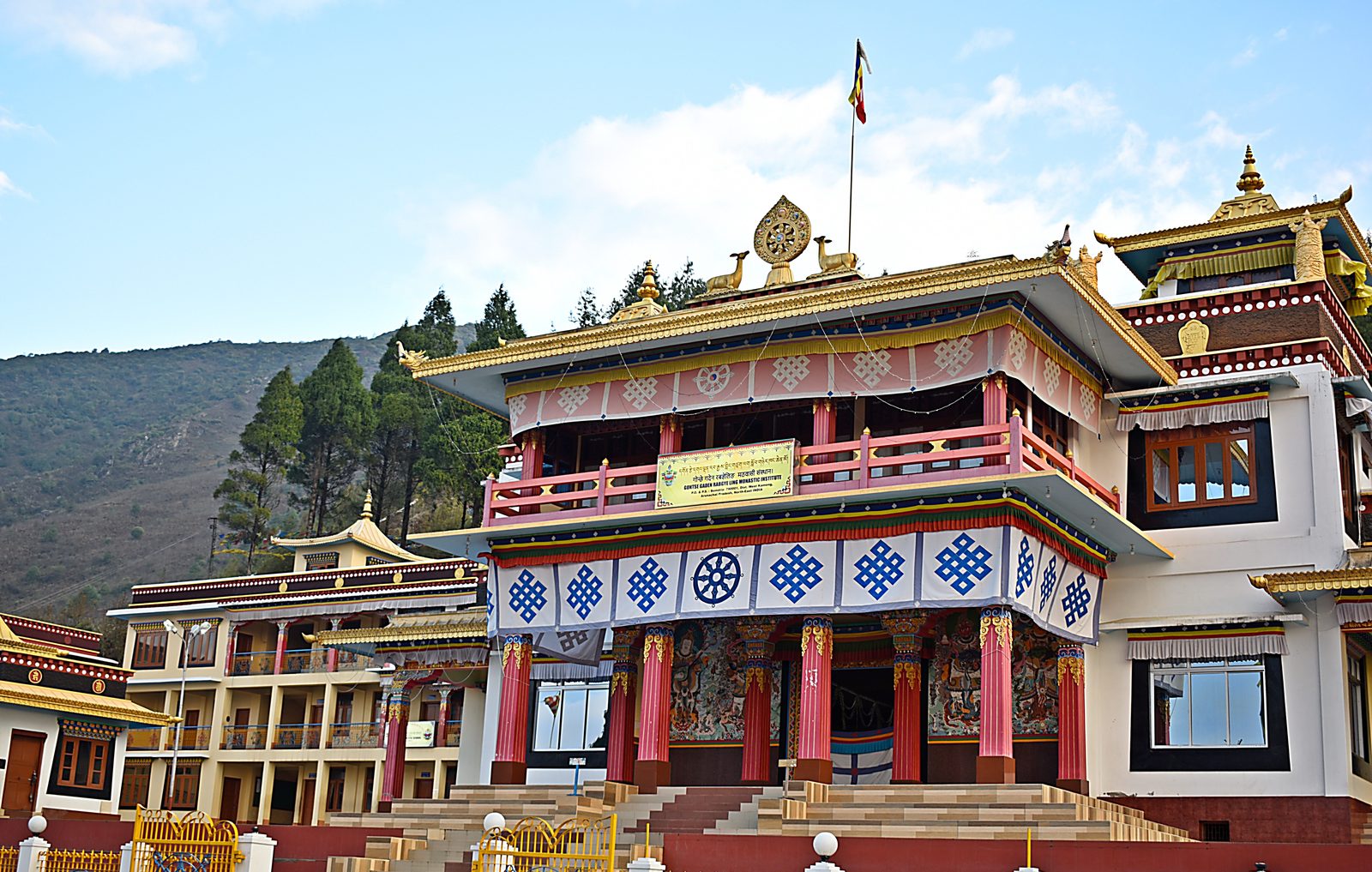
Tawang Monastery — properly Galden Namgey Lhatse, roughly 'the celestial paradise in a clear night' — is the largest monastery in India and the second largest in the world after Lhasa's Drepung. It was founded in the 1680s by Merak Lama Lodre Gyatso, acting on the wishes of the fifth Dalai Lama, and it has been the religious centre of the Monpa world ever since.
It belongs to the Gelug school. Around 400 monks live in the complex, and the sixth Dalai Lama, Tsangyang Gyatso, was born a short drive away at Urgelling in 1683 — a fact that shapes how the whole valley understands itself. The fourteenth Dalai Lama passed through Tawang in 1959 on his flight from Tibet and has returned since; photographs of both visits are displayed inside.
What you actually see inside
The Dukhang (assembly hall)
The three-storey assembly hall is the heart of the complex and holds the eight-metre gilded statue of Buddha Sakyamuni that appears on every postcard of Tawang. Morning prayers here, with several hundred monks and the low register of the dungchen horns, are the reason to arrive early rather than after lunch.
The library and the Parkhang
The monastery holds several hundred manuscripts, including Kangyur and Tengyur volumes, some written in gold. The library is not always open to casual visitors; access is easier with a local guide who can ask properly in Monpa.
The museum
A small but genuinely worthwhile museum holds thangkas, ritual objects, the personal effects of past lamas and material on the sixth Dalai Lama. Allow twenty minutes; most visitors give it five and regret it.
Visiting: timings, etiquette and how long to allow
Etiquette is straightforward and taken seriously. Remove shoes before entering prayer halls, cover shoulders and knees, walk clockwise around shrines and stupas, do not point your feet at images, ask before photographing monks, and stay silent during prayers. Drones are not welcome over the complex.
| Detail | Information |
|---|---|
| Altitude | 3,048 m, on a ridge above Tawang town |
| Typical opening | Around 07:00 to 19:00; museum shorter hours |
| Morning prayers | Early morning, usually before 07:00 — ask your guide the night before |
| Time needed | 2 to 3 hours including the museum |
| Entry | Monastery free; small museum ticket |
| Photography | Allowed in courtyards; restricted or prohibited inside prayer halls |
Want morning prayers built into your itinerary? Tell us and we will time the Tawang day around them.
Request a custom quoteThe best time of day and year
Early morning, in every season. The light on the eastern face of the Dukhang is best before nine, the prayers happen before seven, and the complex is quiet before the day's vehicles arrive from Dirang.
Across the year, October and November give the cleanest air and the sharpest ridge lines behind the monastery. The Torgya festival, held in the winter months of the Monpa calendar, brings masked cham dances to the courtyard and is the single most photogenic event in the valley — dates move each year, so ask before booking around it. Losar, the Tibetan new year, is the other major occasion.
Nearby, and how to fit it into a day
The monastery pairs naturally with the Tawang War Memorial below the town, the Craft Centre, Gyangong Ani Gompa on the ridge to the north, and Urgelling Monastery, the birthplace of the sixth Dalai Lama, about five kilometres out. That is a comfortable full day without driving anywhere far.
In a standard circuit this is the Tawang town day, kept deliberately separate from the Bumla Pass day so that neither is rushed. Both the 6 nights / 7 days itinerary and the compact 5 nights / 6 days version allocate it this way.
Photographing the monastery
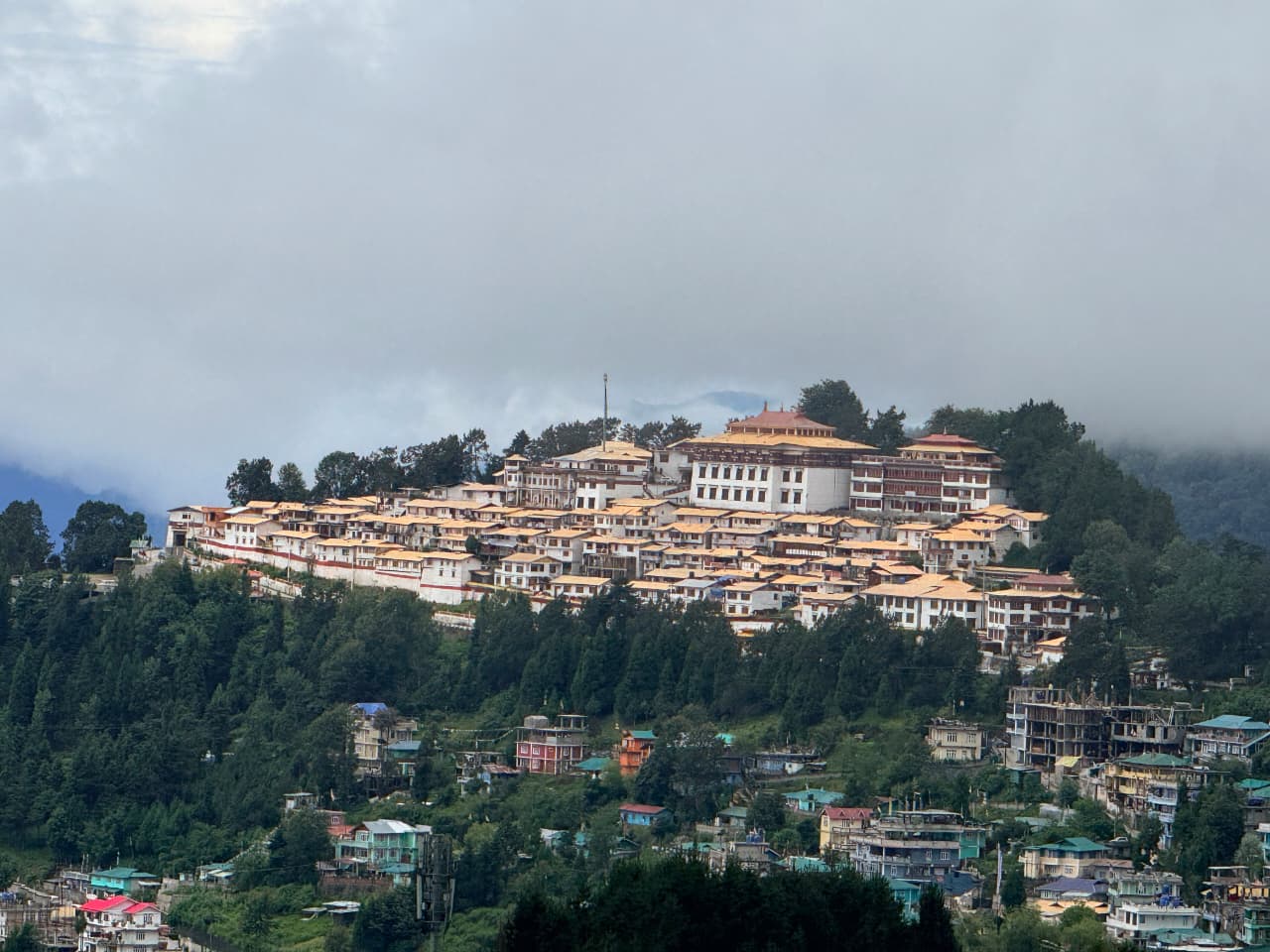
The classic wide shot of the complex on its ridge is taken from the approach road below, best in the first hour of light with mist still in the valley. Inside, the courtyard is the place to work: monks crossing between halls, the light from the upper galleries, and detail on the painted woodwork.
Prayer halls are dim and often off-limits to cameras — respect the notices and ask rather than assume. A fast lens matters more than a long one here. And if you are here for Torgya, get into position an hour before the dances begin; the courtyard fills completely.
Photographers: ask us for the early-light version of the Tawang day.
Request a custom quoteA short history of Galden Namgey Lhatse
The monastery's origin story begins with Merak Lama Lodre Gyatso, who was sent by the fifth Dalai Lama to establish a Gelug seat in the Monyul region. Local tradition holds that the site was chosen by his horse, which wandered off and was found grazing on this ridge — the name Tawang is commonly read as 'the site chosen by the horse'. Construction began in the 1680s and the complex grew outward from the Dukhang into the walled village of monk residences you walk through today.
For most of the following three centuries the monastery was simultaneously a religious institution and the administrative centre of the Monpa valleys, collecting revenue and settling disputes across a region that answered to Lhasa in religious matters long before modern borders were drawn. The 1914 McMahon Line placed Tawang on the Indian side; administration passed formally to India in 1951, and the 1962 war was fought within sight of the ridge.
The sixth Dalai Lama, Tsangyang Gyatso — poet, and the most unconventional figure in the lineage — was born at Urgelling, five kilometres away, in 1683. The fourteenth Dalai Lama crossed into India through Tawang in 1959 and stayed here before continuing south. Both facts are living memory in this valley, not museum captions, and they explain the intensity you feel in the Dukhang at morning prayers.
Weather at the monastery, month by month
| Months | Daytime | Night | What visiting is like |
|---|---|---|---|
| December–February | 2 to 8 °C | −8 to −2 °C | Snow on the courtyard, brilliant light, very few visitors, Torgya season |
| March–April | 8 to 15 °C | 0 to 5 °C | Cold mornings, clear skies, comfortable walking by mid-morning |
| May–June | 13 to 20 °C | 6 to 10 °C | Busiest months, warm and green, occasional afternoon cloud |
| July–September | 12 to 18 °C | 8 to 12 °C | Monsoon cloud, wet courtyards, empty and atmospheric |
| October–November | 8 to 16 °C | 0 to 6 °C | The best photographic window of the year — clean air, sharp ridges |
Tawang Monastery compared with the other gompas nearby
A well-built Tawang town day takes the monastery at first light, Urgelling and Gyangong mid-morning, the War Memorial and Craft Centre in the afternoon, and leaves the Bumla Pass run for its own day. Trying to add Bumla to this list is the single most common way visitors ruin both.
| Monastery | Distance from town | Time needed | Why go |
|---|---|---|---|
| Tawang Monastery | 2 km | 2–3 hours | The main event: Dukhang, museum, library, morning prayers |
| Urgelling Gompa | 5 km | 30 minutes | Birthplace of the sixth Dalai Lama; small, quiet, deeply atmospheric |
| Gyangong Ani Gompa | 5 km | 45 minutes | Nunnery on a ridge with the best wide view back to the monastery |
| Brahma-dung-chung Ani Gompa | 12 km | 45 minutes | The oldest nunnery in the district, on the Zemithang road |
| Taktsang Gompa | 45 km | Half day | Cliff hermitage associated with Guru Padmasambhava |
Ask us to schedule your Tawang town day around morning prayers rather than checkout time.
Request a custom quoteLocal tips most visitors only learn afterwards
Ask the night before what time prayers start; it moves with the season and the lunar calendar, and no printed source is reliable. Arrive fifteen minutes early, sit at the back of the Dukhang, and stay put until the monks begin filing out.
Carry small notes if you intend to offer a donation, and butter-lamp oil is sold at the gate if you want to light one. Shoes come off outside every hall — wear something you can slip on and off without sitting down on a freezing step.
The monk residences behind the Dukhang are a working village, not an exhibit. Walk through, greet people, and photograph doorways rather than families unless you ask. The tea shop just inside the outer gate makes the best butter tea most visitors will drink on the trip.
In winter, the courtyard flagstones ice over before dawn and stay slick until the sun clears the eastern wall. Boots with grip matter more here than at Sela, where you barely leave the vehicle.
Where the monastery sits in the wider circuit
Every itinerary we run reaches the monastery on the day after the Sela Pass crossing, once travellers have slept a night at 3,048 metres. The Bumla Pass day follows, then the return over Sela to Dirang. If you have only read one other page before this, make it the Sela Pass guide — it decides whether you arrive on schedule at all.
For planning the whole trip, the Tawang tour package hub explains how the days are assembled; the 5 nights / 6 days and 6 nights / 7 days itineraries show the two most common shapes. Travellers arriving in winter should also read the snowfall guide before fixing dates.
Plan the trip
Tawang trips built around the monastery
Dawn prayers, Urgelling and the Giant Buddha need an unhurried Tawang day rather than a stopover. Here is how that day sits inside a full circuit.
The calculator is a planning tool, not a booking form — it gives an indicative budget by group size, nights and hotel category before you ask us for a quote.
Tawang Monastery: photographs
Photographs of this route, with the source credited beneath each frame.
The gilded Shakyamuni in the Dukhang — the heart of Tawang Monastery's main assembly hall.Tawang Monastery (Galden Namgey Lhatse) · Photo: Living Roots Tours & Adventure Novices leaving the Dukhang after morning prayers — the courtyard is busiest between 6 and 8 a.m.Tawang Monastery courtyard · Photo: Living Roots Tours & Adventure Galden Namgey Lhatse on its ridge — the largest monastery in India.Tawang town · Photo: Living Roots Tours & Adventure The 8-metre Buddha above Tawang town, a five-minute drive from the monastery.Tawang town · Photo: Living Roots Tours & Adventure
Location map
Nearby attractions
Recommended itineraries
- 5 Nights / 6 Days Tawang TourThe compact circuit — Sela, Tawang Monastery, Bumla and Sangetsar with no spare day.
- 6 Nights / 7 Days Tawang TourAdds a Nameri/Bhalukpong area route break on day one, with three nights in Tawang and a Bomdila night.
- Tawang Tour PackageThe planning hub: durations compared, inclusions, permits, vehicles and stays.
- Luxury Tawang ToursPremium stays, private vehicles and a slower pace on the same route.
Tawang Monastery: frequently asked questions
- How old is Tawang Monastery?
- It was founded in the 1680s by Merak Lama Lodre Gyatso at the wish of the fifth Dalai Lama, making it roughly three and a half centuries old and the largest monastery in India.
- What are the Tawang Monastery timings?
- The complex is generally open from around seven in the morning until early evening, with the museum keeping shorter hours. Morning prayers start earlier still — ask your guide the previous evening, as the time shifts with the season and the calendar.
- Is there an entry fee for Tawang Monastery?
- Entry to the monastery itself is free. There is a small ticket for the museum, and donations are welcome but never demanded.
- Can I photograph inside Tawang Monastery?
- In the courtyards, yes. Inside the prayer halls, photography is restricted or prohibited depending on the hall and whether prayers are in progress. Always ask before photographing monks, and do not fly drones over the complex.
- How much time should I spend at the monastery?
- Two to three hours does it justice, including the museum and a walk around the residential lanes of the complex. Visitors who allocate forty minutes see a statue and miss the place entirely.
- Can foreign nationals visit Tawang Monastery?
- Yes, with a Protected Area Permit for Arunachal Pradesh. Unlike Bumla Pass, the monastery has no additional restriction on foreign visitors.
Who wrote this
Living Roots Tours & Adventure
Living Roots Tours & Adventure is a Northeast India-based ground operator organising customised Tawang and Arunachal Pradesh journeys from Guwahati. Vehicles, local services, guides and accommodation are arranged according to the itinerary, group size and travel conditions. Where something is uncertain — a pass, a clearance, a season — we say so rather than smoothing it over.
- Base
- Northeast India — trips planned and operated from Guwahati, Assam
- Vehicles
- Experienced hill drivers and suitable vehicles arranged for the complete route
- Phone / WhatsApp
- +91 60019 80680
- dmclivingroots@gmail.com
Keep planning
Where to go next on this site
Tawang packages
- Tawang tour packageMain planning page — routes, permits, inclusions
- 5 nights / 6 days Tawang packageThe compact Guwahati–Tawang run
- 6 nights / 7 days Tawang packageBest balance of pace and weather margin
- Luxury Tawang toursPremium stays and private vehicles
- Tawang group toursSmall-group journeys arranged when a suitable group is confirmed
- Tawang fixed departuresContact us for the next confirmed small-group departure
Travel guides
- Bumla Pass guide
- Best time to visit Tawang in winter
- Tawang snowfall month by month
- Guwahati to Tawang road trip
- Tawang permits, ILP and travel basics
- Sangti Valley guide
- Mago Valley guide
- Thembang village guide
- Best time to visit Tawang
- Tawang weather by month
- Tawang packing list
- Tawang trip budget guide
- Inner Line Permit: how to apply
- Bumla Pass permit process
- Tawang with family and kids
- Tawang honeymoon guide
- Tawang photography guide
- Tawang food guide
- Monpa culture guide
- Tawang festivals and Torgya
- Dirang travel guide
- Bomdila travel guide
- Tawang FAQs
- Shergaon travel guide
- Zemithang travel guide
- Mukto village guide
- Mandala Top guide
- Luxury Tawang travel guide
Planning the whole trip rather than one stop? Start with our Tawang tour package page — it covers routes, permits, seasons, stays and how a Tawang trip is quoted.